Saturday, 5 June 2021

 Pen y Bannau, Pontrhydfendigaid


A quick jaunt up to this hillfort between jobs in north Ceredigion yesterday yielded Schistidium frigidum in small, tight cushions on the crag. A small patch of Heterocladium heteropterumin an underhang at the base of the crag with Amphidium mougeotii and Rhabdoweisia crispata, had me mistakenly claiming Pterigynandrum filiforme until Tom pointed out that, although similar in their textbook descriptions, they are rather different in reality with the rarer species being a much neater plant. At least I have a proper search image now....


Heterocladium heteropterum


Wednesday, 2 June 2021

 Mossing on the Side


Early morning by the harbour at Ward's Yard

Most of my bryophyte recording at the moment is done in the ten minutes before starting a bat survey, or whilst carrying out breeding bird surveys in the early morning (I am still listening....). 

Amblystegium confervoides from the base of a wall on a ruined barn near Gwyddgrug in Carmarthenshire is, I think, only the second county record but less likely to be of concern to the planning system than the couple of pipistrelle bats inside. Syntrichia virescens on a concrete wall at Ward's Yard, Milford Haven is not far from one of Sam's three recorded locations, although perhaps not as interesting as the dwarf mouse-ear Cerastium pumilum new to south Wales on some limestone chippings between old railway lines nearby. The Syntrichia ruralis ssp. ruralis with ripe capsules alongside seems to represent the first fruiting record for Pembrokeshire.


Didymodon tomaculosus location, pond edge at Lower Harglodd

I was pleased to finally find Didymodon tomaculosus on the clay edge of a pond at Lower Harglodd, the Bug Farm near St David's. My record shot of the sausage-shaped rhizoidal gemmae isn't worth uploading, but confirmed it as the second county record. Riccia beyrichiana, Weissia rutilans, Entosthodon obtusus and Physcomitrium pyriforme and Ephemerum crassinervium ssp. sessile were among the other species on the pond edge.


Ditrichum pusillum track near Neath

Straying into south Wales blog territory, I found yet more Ditrichum pusillum whilst doing bird survey near Cimla, Neath - Sharon confirmed it as new to VC41. It must be widely overlooked in mundane acidic tracks such as this. It may also be overlooked, or passed over for Dicranella varia / howei on limestone-surfaced tracks too, as I've just found a small amount on my farm track, just 50 yards from the house. How many years has that taken me....


Monday, 24 May 2021

Iet Wen Quarry, Glandwr


The working quarry at Garn Wen is obvious as one drives south from Crymych along the Pembrokeshire / Carmarthenshire border, but there are three smaller, disused quarries within a short distance of each other to the north of there. What's striking about these is how different from one another they are. The old slate quarry on the hill at Foel Dyrch is typically dry and acidic, with Ditrichum lineare and Grimmia donniana amongst the notable species. A few hundred metres to the east and lower down the flank of the hill, the narrowly incised shale quarry at Foel is damp and shaded, with Platyhypnidium lusitanicum, Philonotis arnellii amongst a luxuriant growth of commoner species.

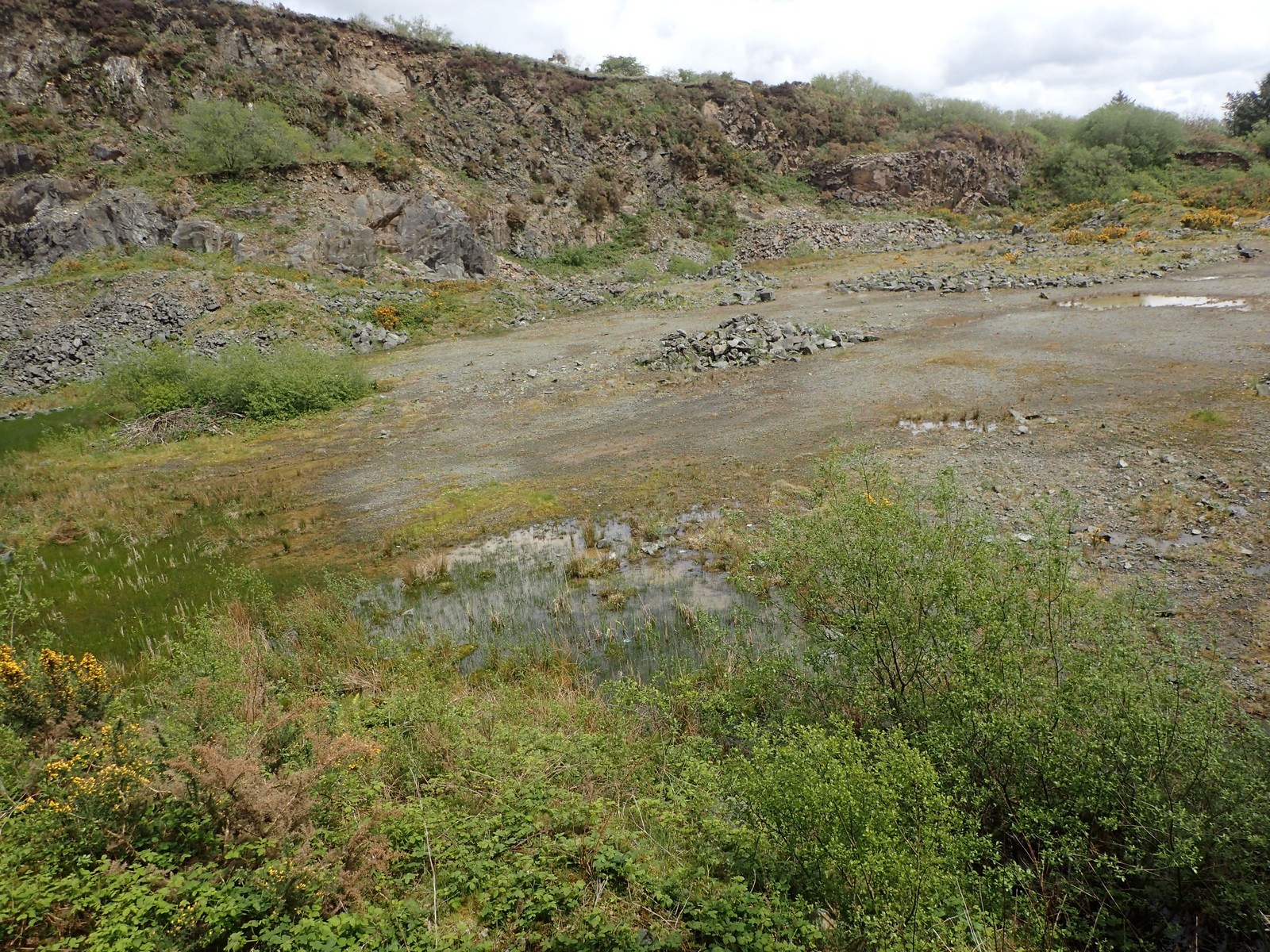
I'd looked at the third of the trio, the dolerite quarry at Ietwen, once before but thought it worth another crack. Fortunately it hadn't changed much - it's still vegetating naturally, and peregrines and ravens were much in evidence.

The dolerite introduces some base-richness to the flora, and this is the only site that I know in the county where Encalypta streptocarpa grows on a cliff rather than a lime-mortared wall - it's patchily abundant in the north-west corner. Aloina aloides is in places on soil amongst boulders on the quarry floor with Bryoerythrophyllum recurvirostrum and some Trichostomum brachydontium. There is also an abundance of Weissia, mostly W. brachycarpa var. obliqua but also W. controversa var. controversa and perhaps some W. rutilans on the damp floor with Archidium and some Bryoerythrophyllum ferruginascens.


Encalypta streptocarpa with maidenhair spleenwort


Weissia brachycarpa var. obliqua

Perhaps the other interesting feature of the quarry is the occurrence on rock of species which are more typically epiphytic. There is a tiny amount of Colura calyptrifolia on the north-facing igneous cliff, whilst Cryphaea heteromalla grows through Orthotrichum cupulatum on one rock. A small amount of what seems to be Zygodon rupestris may need double checking, as I haven't found gemmae yet. More typical saxicolous mosses here include Ptychomitrium polyphyllum, Grimmia trichopylla, Schistidium crassipilum and some Hedwigia stellata.

There were two additions to the Rare Bryophyte Register which I'm slowly drafting - Dicranella subulata which was fruiting in small quantity in one corner of the quarry, and Ditrichum pusillum which was amongst Bryoerythrophyllum recurvirostrum on the damp edge of the entrance track. I've now found four track-edge sites for the Ditrichum in north Pembs in as many months.


Saxicolous Colura calyptrifolia


Cryphaea heteromalla with Orthotrichum cupulatum


Monday, 3 May 2021

 Bryum dichotomum 'Cornish variety'

I've been clearing my desk before summer's bryological hiatus, and I came across a funny Bryum which I'd collected three years ago from the yard at Castle Bay Seafoods near Tier's Cross. It has dense clusters of oval brown gemmae in the leaf axils, but otherwise looks like Bryum dichotomum. I recalled David Holyoak had a picture of something like it in his new Bryum book. Sure enough, the specimen matches a rare taxa known only from Cornwall and the Netherlands, which is only tentatively and provisionally placed within B. dichotomum. DNA work failed to distinguish it from B. dichotomum, but the same study also failed to differentiate B. gemmilucens from either, so perhaps there is some more work to be done there. The seafood company, incidentally, are exporting shellfish to France and Spain, so there's plenty of opportunity for importing mosses on lorry tyres too. The sea storksbill on the yard is one of the few inland populations in the county.


 Ffynone


Very little in the way of mossing could sensibly be done during the April drought. I did take the opportunity to call in at Ffynone while water levels were down, with a couple of target species in mind. I didn't find any of the miniscule liverwort Sphenolobopsis pearsonii, which Tom had shown me at Cwm Rheidol earlier in the winter. I did, however, find some Heterocladium wulfsbergii above the main waterfall, which was new to the county, and in a very typical location.

Some Bartramia fruiting on the cliff above the fall initially looked good for B. ithyphylla, until I keyed it out. I then read Sam's flora account for B. pomiformis: "wispy-leaved plants with Diplophyllum albicans and Diphyscium foliosum on a rock face by Ffynnone waterfall raised hopes of Bartramia ithyphylla, but proved to be B. pomiformis var. crispa (Dixon, 1924)". It really is invaluable to have such a good flora to follow.


Bartramia pomiformis var. crispa