Tuesday, 21 March 2023

Bryum cf. gemmiparum again


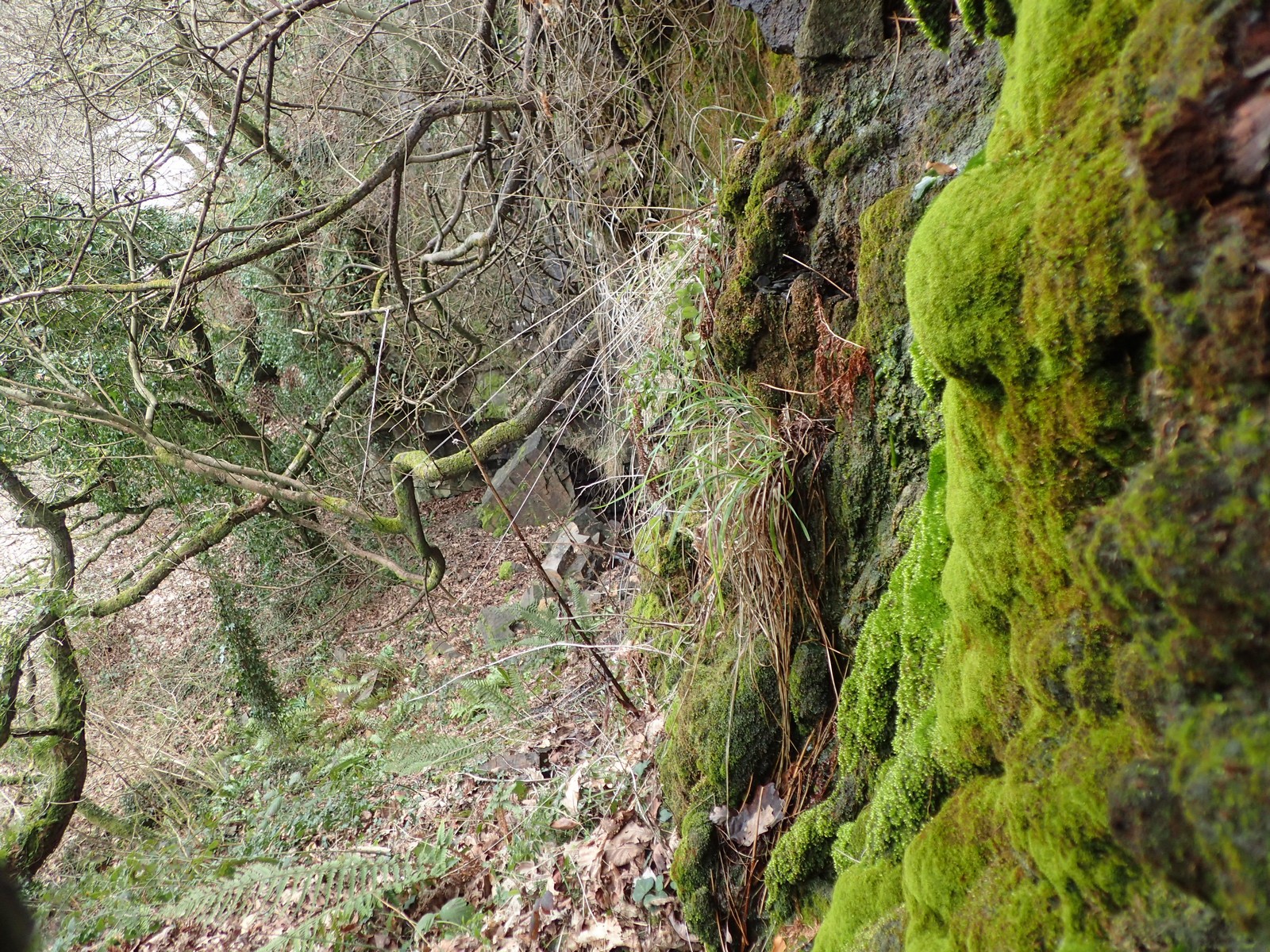
A spring tide gave me a chance to revisit the cove near Tenby with putative Bryum gemmiparum. Although there are a few cushions on irrigated shale rockfaces, I didn't manage to find any bulbils so it still won't be confirmed. These photos do look convincingly similar to those of the real thing though.


Monday, 20 March 2023

 Treffgarne and Rosebush


There's a flooded quarry by the main road just north of Treffgarne which I'd kayaked on once, but never mossed in. Lots of Lophozia excisa fruiting happily on the track on the way in. A climb up to the millstone grit crag at the back of the quarry initially seemed disappointing, but I collected a specimen of a small, slender pleurocarp from the base of it which appears to be a good candidate for Homomallium incurvatum. I may be guilty of showing my workings again.....(I was, as Tom Blockeel helpfully confirmed - although macroscopically right for Homomallium, the alar cells are too irregular and incrassate - the illustrations in Smith's flora are apparently very misleading).


A somewhat similar but slightly larger pleurocarp from the wooded area below has deciduous branches and appears to be Platygyrium repens which would be a county first. 

On to Treffgarne Tors, where I located Bazzania trilobata and Hymenophyllum tunbrigense, but not the Lepidozia cupressina. Various patches of Lepidozia reptans, but if its uncommon relative is still there, it's not doing very well. I carried on to Puncheston, where the common at Waun Fawr is definitely in trouble - rank Molinia over the once lovely flushes. I went on to Rosebush Quarry instead, where the Cynodontium tenellum appeared to be flourishing, and cushions of Sphagnum russowii were looking good.


Sphagnum russowii mixed with fimbriatum


Cynodontium tenellum

The last moss of the day, from lime mortar on an old quarry building, proved to be the most interesting. The long mucro on this Aloina seems to make it Aloina obliquifolia, a European species which isn't on the British list. Such mucronate specimens are assigned to Aloina rigida var. mucronata in the UK, despite being distinguished as A. obliquifolia in the European checklist. It certainly looks different to and much larger than the blunt-leaved rigida that I'm familiar with from Pendine and the south Pembs limestone. There was only one small patch of it, but it had ripe capsules.


Aloina obliquifolia


Thursday, 9 March 2023

By Hook or by Brook


Sanionia uncinata habitat, Eastern Cleddau

Waders on for some otter survey work for NRW around Gweunydd Blaencleddau SAC this week. First a chance to finally find some Sanionia uncinata in the county, which had eluded me thus far. Some good patches on grey willows sprawling across the channel. 


Sanionia uncinata

I'll confess to not being particularly experienced with hook mosses, so I went up to the flushes on Dolau isaf to refresh my memory. The Scorpidium cossonii was easy enough, but there was a Palustriella at the top end below the main calcareous spring that I had to collect. 


Under the microscope, the shape of the stem leaves suggested that it wasn't falcata - the regular species of base-rich springs on Preseli, but commutata. I tried to turn it into decipiens, thinking that I'd found papillae as well as prorate cell ends:


Although they looked tall and conical to me, Sharon concluded that these are still just prorate cells so, unsurprisingly, my speculative attempt at a new species for Wales were quashed.  However, with Palustriella commutata dominant and Cratoneuron filicinum frequent, this represents a small area of an Annex 1 habitat previously overlooked on the site - Petrifying Springs with Tufa formation (Cratoneurion). In common with many Welsh examples it lacks the tufaceous element. It narrowly escaped some channel excavation work done in the name of southern damsefly conservation, which stop just 3m short of the patch. 

I thought that the Pohlia around three of these spring heads might bet wahlenbergii var. glacialis, quite tall and with some mid-leaf cells around 30um wide. Sharon corrected me again - the leaf shape is a better fit for var. wahlenbergii and it's just a tall version of that.


Pohlia wahlenbergii and habitat

Back on the river again, I checked a few willows and rocks for Harpalejeunea molleri which grows in the next valley over, but no joy. Lots of otter spraints to record on the rocks though, and couches amongst the sedge tussocks. Mink evidence too. Willow tits in four places - this is a proper hot-spot for them. 

Sunday, 26 February 2023

 Monkstone - Waterwynch


Bryum cf. gemmiparum

There are a couple of small bays between Waterwynch and Monkstone, north of Tenby, which are only accessible for an hour or two on the lowest spring tides. I only managed five minutes poking about whilst on a family walk there last week, but it was long enough to collect an interesting looking Bryum from wet ledges on the mudstone cliffs at the back of one bay. No camera with me so no in situ photos, but the cushions look exactly like the B. gemmiparum photographs in Michael Luth's flora. The leaves are a good fit too, with the same snub-nosed apex, and a wide costa (99 microns) at the leaf base. Unfortunately no bulbils on the tuft that I collected, so it remains to be seen how it will be refereed ('looks interesting but can't be confirmed without bubils' - Sharon), but I think Bryum alpinum is ruled out on costa width amongst other characters.


I went back a couple of days later, but the tides were no longer big enough for easy access. I went round to the Saundersfoot end of the beach instead, where a new sub-population of Philonotis rigida - the seventh on this section of cliffs - was some compensation.


Cushions of Bryum pseudotriquetrum and Amphidium here 
have scattered tufts of Philonotis rigida


Thursday, 23 February 2023

Cemaes Head


There's a lovely little flush on the south side of Cemaes Head in north Pembs, over a slippage where a stream meets the cliff top. It's about as natural as a habitat gets around here. I'd recorded a good population of Didymodon spadiceus amongst the abundant Philonotis fontana here around three years ago, but a revisit this week revealed that I'd missed the single small patch of Philonotis rigida on one small rock. This rarity must be a good colonist of such habitats, relying on periodic erosion events, and I suppose it's just possible that it had colonised in the meantime. There's a small population in a similarly isolated flush on the cliffs south of Moylgrove, a few kilometres down the coast. 


Philonotis rigida

I'd definitely missed the Nardia compressa on my last visit, the red patches of which were prominent on flushed rock a little higher up. The few other county records are on Mynydd Preseli and Rosebush quarry. 


Nardia compressa is on the flushed rock here

A jumble of shale boulders higher up the slope had a few small tufts of Grimmia montana, which I was particularly pleased to find, as I've never been able to locate the single tuft that Sam found on the south coast near Monkstone Point. His flora entry says that "remarkably, Campylopus pilifer grew on the same rock". Even more remarkably, Campylopus pilifer grew on my rock too, and both finds were on the same date, just 15 years apart.


This dry boulder top has Campylopus pilifer, and, just out of shot, some Grimmia montana