Sunday, 4 April 2021


Waterfall Walk

A fine day, not too warm, and with a few hours available led me to visit a site I’d not been to before in spite of it being only a few miles away from my home as the kite flies.  Arthur had told me it was worth getting to and he had visited it with Sam in May 2004 so I knew what I was likely to see and there was one particular moss I was interested in refinding.

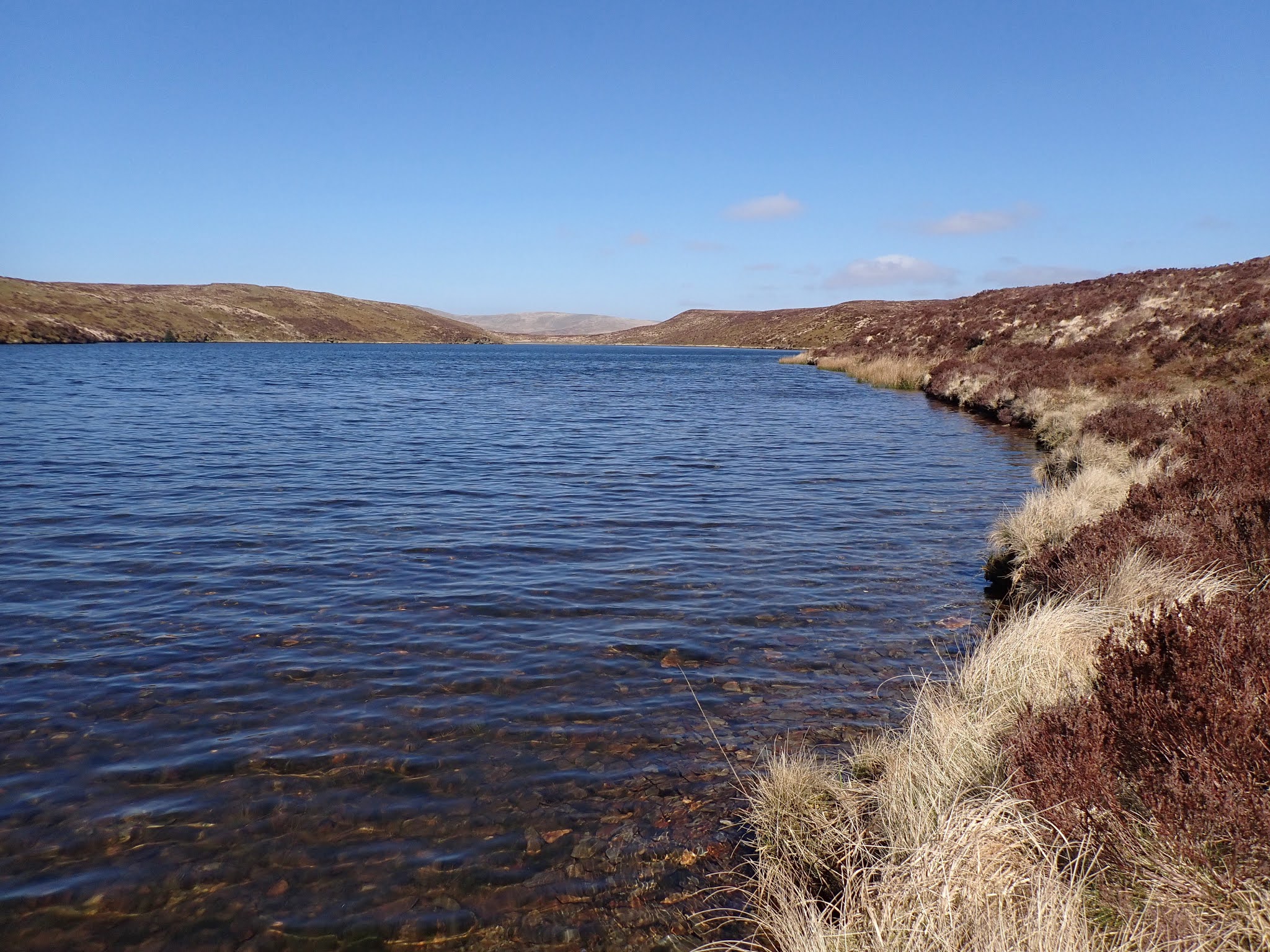
The walk starts from the now-derelict Dyffryn Castell on the main road and heads SE through the farm at the foot of the hill.  Then a slog up the track before branching off on a tiny footpath across the moorland until one of the lakes called Llynnoedd Ieuan  is reached:

This lake itself has so far proved unremarkable bryologically, as a previous visit with Tim Rayner had shown, but there are another two lakes to explore another day.  

Pressing on across the moorland, the land suddenly drops away and the small stream drops over the edge in a spectacular waterfall.

By dropping down through the forestry and then working back up the stream, it’s not too difficult to reach the bottom of the falls.  Most of the rock is clearly acidic and, although it’s possible to work up the edge of the series of cascades that make up the waterfall (unlikely as it looks on the photo), the bryophytes tend to be very common things like Scapania and Marsupella. It's not a very big stream and may well dry up completely on occasion and it also faces south.  But there are a few pockets of strongly calcareous rock at the bottom which are easily detected by the presence of huge cushions of Tortella tortuosa with a few patches of Pohlia cruda.


Then at the bottom of a few of these rocks are cavities where the delightful Isopterygiopsis pulchella grows, a plant I’d not previously seen in the county.  A few setae are visible in the photo for this is a monoicous moss, unlike some of its look-alikes.

 Associated bryophytes here were all common things like Heterocladium flaccidum and Mnium hornum, all carefully checked of course.


I didn’t have time to thoroughly explore the site but I managed to add a few more mosses and liverworts to Sam’s extensive list and then it was back across the moorland with a few Wheatears for company.

Friday, 2 April 2021

 Brechfa Forest

I picked up a job in Brechfa Forest on Wednesday, monitoring some translocation work which had been undertaken in association with the wind-farm. Populations of Pohlia drummondii and Campylopus subulatus had been moved when new tracks had been constructed a few years ago, and distributed along two unsurfaced tracks. Both had quickly dwindled as vegetation cover increased, and the Pohlia had disappeared from both receptor sites by 2019. It persists on one of the two ditch-side locations found in 2019, although it appears to be much less frequent than it was then, and less abundant than the Pohlia bulbifera alongside. 

The Campylopus hangs on in small quantity on one of the receptor sites - a damp, shaded track, where it struggles alongside Sphagnum denticulatum, S. cuspidatum and Polytrichum commune. I found a few plants of Atrichum crispum in one of the few more open patches here. 


Atrichum crispum

Perhaps unsurprisingly, given its abundance on forestry tracks further north, a deviation from the monitoring spec revealed Campylopus subulatus to be abundant and sometimes dominant on various sections of secondary track, which are still surfaced with local shale and more acidic than the new limestone ones as a result. Tom tells me that there may be cryptic species within a subulatus aggregate, and Ceredigion specimens are amongst those being sequenced at the moment. Still no Bryoerythrophyllum campylocarpum to be found with it, but there was some B. ferruginascens (including an all green form which had caused us both confusion when I first collected it from a site near Aberystwyth last month). Some fruiting Weissia rutilans in a few places as well, which may or may not still be locally rare.


Typical Campylopus subulatus track


Monday, 29 March 2021

 Tywi Forest


Clear-fell at Ochr-fawr

I've been up in the Tywi Forest east of Tregaron for the past couple of weeks, recording peat depths to inform restoration of sitka spruce plantations to bog as part of a National Peatland Action Programme. Let's hope that NRW are able to make headway with restoration in other plantations too.

Unsurprisingly, the clear-fells tend to be hard-going bryologically as well as physically. There are already pockets of Sphagnum-rich vegetation, sometimes with Sphagnum capillifolium and papillosum alongside the more regular palustre, fallax, fimbriatum and subnitens. Orthodontium lineare was frequent on ditch edges and stumps, although hardly troubling the Campylopus introflexus for the title of most aggressive non-native species. The only less common species found were a couple of cushions of Dicranum fuscescens on peaty soil, and a small patch of Tetraplodon mnioides on a presumed old fox scat atop a prominent log.


Tetraplodon mnioides growing through Hypnum jutlandicum


Orthodontium lineare

A bit of crawling alongside the limestone forest tracks produced patches of Weissia rutilans, often mixed in with Archidium, which I've always thought could have been called Scouse Moss (bit of a niche joke perhaps....). Also a small patch of Anomobryum julaceum on one damp, silty edge - perhaps a slightly atypical habitat, and I was even mildly disappointed that it wasn't Aongstroemia when I put it under the microscope.


Anomobryum julaceum was on the track edge here

Finally, a quick wander off onto an adjoining hillside produced the first Bryum bornholmense for Ceredigion, a colonist of open ground amongst burnt Molinia tussocks.


Wednesday, 10 March 2021

Cors Bryn Mawr


I finished work up past Lampeter with an hour or two of evening light to spare last week, so revisited the small but rather nice bog perched up on the ridge on the Carmarthenshire side of the county boundary with Ceredigion. I'd found some Sphagnum medium, a rarity in the county, whilst trying to learn Sphagna there six years ago. I wondered if there was anything else interesting lurking in this seemingly little-visited spot. 

I must have learnt a few more Sphagna since then, as I found several patches of Sphagnum molle along a few metres of channel on the south side. This is another species with few Carmarthenshire records. The extensive lawns of Sphagnum cuspidatum were edged with plenty of S. papillosum, and Kurzia trichoclados, Odontoschisma sphagnii and Cephalozia pleniceps were on samples of this and Sphagnum subnitensSphagnum quinquefarium was more of a surprise - a single patch was tucked under a self-set sitka spruce sapling in a perhaps unusually wet location for this species. Another small sitka had managed to catch some Usnea articulata.


Sphagnum molle

Sphagnum quinquefarium


Usnea articulata


Small base-rich flushes on the slope to the south-east had typical species including Scorpidium scorpioides, S. cossonii, S. revolvens and Campylopus atrovirens. I couldn't find any of Tom's mosses on the forest tracks nearby, all samples proving to be Barbula convoluta.


Monday, 1 March 2021

A New Moss for Wales


A New Moss for Wales

A lockdown moss found by a gravel track through woodland near the author’s home in Cardiganshire proved to be more interesting than first thought.  It looked like a rather long-leaved form of Barbula in the field but, on closer examination, the basal cells were clearly wrong for that.  It was provisionally thought it might be a Didymodon, possibly related to D. umbrosus which has similarly enlarged median basal cells but it sat on the desk for a while, in some danger of being put in the bin.  Then eventually I sent it to Tom Blockeel who, by chance, had collected something rather similar in Ireland nearly 20 years ago which had had some of the characters of Bryoerythrophyllum campylocarpum but had never been satisfactorily confirmed as that.  But this time we were able to get Jan Kucera involved and he has now sequenced a Welsh specimen and confirms it as B. campylocarpum.  He comments that it’s a little closer to samples from Cameroon than from its only European sites in northern Portugal.  It is primarily a tropical species.


Since the first collection, it has now been found at 4 points along the same forestry track plus one other site about 1 km away.  The later site is however a very different habitat.

In appearance, short leaved forms (the pictures here are of plants with more elongate leaves) look a little like B. convoluta in general appearance, no doubt influenced by the unprepossessing habitat.  The Welsh plants are a similar colour too, being quite light green but in Ireland it is more brick-red in colour.  At the Goginan site however, no Barbula of any species has actually been found, the shale used to make the track resulting in quite acid conditions.  The commonest associated bryophyte on the forest track is Campylopus subulatus but there are also species of Polytrichum s.l., Pohlia annotina, Scapania irrigua and other frequent species of acid, well-drained gravelly soils.  Long-leaved forms look more like a very small Trichostomum tenuirostre to use an older name, sometimes even with comal tufts at the tops of the shoots.  It is however only 5 – 8 mm high.

The leaf apex is interesting too.  The upper cells are strongly papillose, making the 12 micron quadrate cells hard to pick out sometimes.  But there is a projecting smooth mucro formed from 1 – 4 cells which is a real contrast.  The mucro sometimes has a spine on the side and this can result in it appearing as a nearly symmetric fork.

Leaf margins are unbordered but with the margin recurved in the lower part of the leaf. 

Unsurprisingly, there are similarities to B. recurvirostrum.  It too has differentiated basal cells although there are many more rows of rather narrower hyaline cells across the base.  But it does also have a few rows of narrower chlorophyllose cells towards the basal margin and even a single row of hyaline cells up the basal margin.  Its preferred base-rich habitat would make it an unlikely candidate for confusion though.  The simplest difference is of course the strongly recurved margins extending nearly to the leaf apex whereas B. campylocarpum has marginsonly recurved in the lower part of the leaf, sometimes hardly recurved at all.  The upper part of the leaf is much narrower too.

The other site mentioned is on a low vertical rock face by the edge of a ditch.  The plants are small here and would be likely to be overlooked as Dichodontium pellucidum perhaps or even just a tiny Trichostomum tenuirostre.

The plants found to date have all been sterile (but see update below), supporting the notion that it is likely to have been introduced.  It seems possible that the Irish plants might be distinct so we could be looking at separate introductions (but see below too).  In any case it’s hard to see why it should only be in Goginan and there are very many miles of similar track in Cardiganshire.  If you factor in ditch banks then there is clearly scope for it to be quite widespread in occurrence.  In Portugal the few sites for it are acid to circum-neutral but also on tracks.  At the Goginan site the track is much used by cyclists and it can be safely assumed the plants are being spread vegetatively (by rhizoidal tubers) so that seems a likely means of transmission.

It will all be written up of course but it would be good to have more sites.  It’s probably best to start by sampling any Barbula that looks a bit long-leaved and then to check the basal cells.  This could well prove to be another moss that has slipped in 'under the radar'.

Update early April 2021.  There is a lot of this moss on the waterfall walk at Devil's Bridge.  It's about 2/3 of the way up the path that goes up the side of the falls and is on fine silt covering flattish rocks that the path crosses.  It's a rather shorter-leaved form and the basal margins are hardly recurved so it was overlooked as Trichostomum brachydontium on previous visits.  It's hard to say how long it's been there and T. brachydontium has been recorded from the site for years although that does genuinely occur in a few places.  The new moss is on the path above Jacob's Ladder too.  Rhizoidal gemmae were found and they are dark wine-red in colour with very large cells (up to 90 microns) and have so far defied attempts at photography.  Tom Blockeel is investigating them further.  A couple of the plants collected had immature archegonia forming.  Jan Kucera has now shown the Irish population to be genetically similar to the Welsh.

Tom